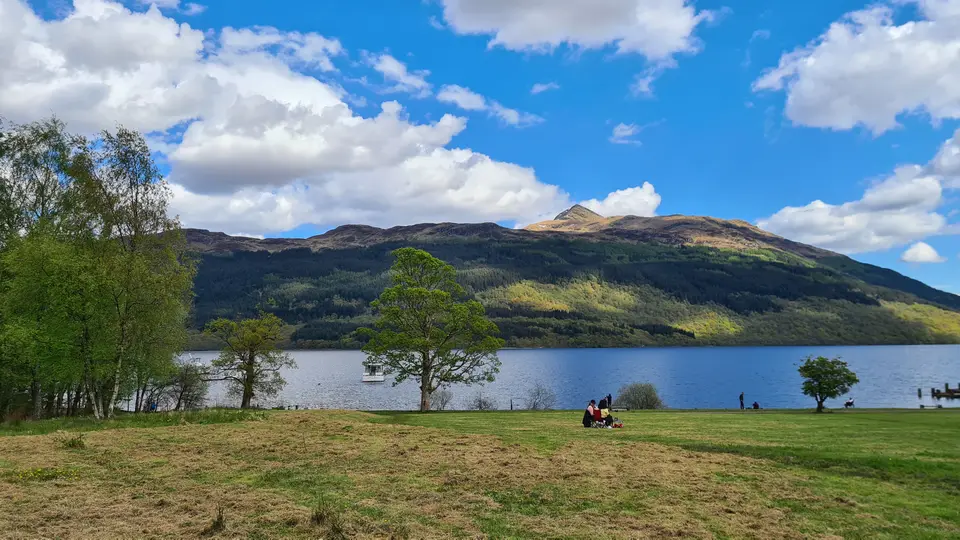

The Loch Lomond song
A traditional Scots song of parting, first printed in Edinburgh around 1841, author unknown
“The Bonnie Banks o’ Loch Lomond” is a traditional Scots farewell between two lovers, and in its best-known reading the “low road” is death. Nobody knows who wrote it, the first known printing is an Edinburgh song sheet of 1840 or 1841, and the Jacobite story behind the low road is a tradition, not documented history. Runrig’s Hampden version is the 2007 charity single “Loch Lomond (Hampden remix)”, a number 1 in Scotland. Below: the traditional words, Runrig’s versions and where to hear them, and where to see Ben Lomond from the banks.
- First printing
- 1840/41
- Roud index number
- 9598
- UK peak, Runrig, 2007
- No. 9
- Hampden fans, 2007
- 50,000
What is the Loch Lomond song about?
It is a farewell, and the “low road” is usually read as death: the singer will die, and his spirit will be back in Scotland before his love can travel home. The verses remember the banks and hillsides where the two walked, then comes the chorus everyone knows: you take the high road, I take the low road, and I will be in Scotland before you, but my true love and I will never meet again on the banks of Loch Lomond. The last verse says that birds sing and flowers return every spring, but a broken heart gets no second spring.
The usual reading of the low road is death. Robert Ford, who printed these words in 1899, recorded the tradition that they were the farewell of one of Prince Charlie’s followers to his sweetheart before his execution at Carlisle after the 1745 rising: the low road was the grave, and his spirit would reach Scotland before she could travel home. Ford called it a tradition, and the Traditional Ballad Index still calls the link with the ’45 uncertain. Treat it as the song’s best-known interpretation, not as history.
Two things the lyric sites leave out. The song is a lament, yet it is often sung brightly: the music historian John Purser, quoted by Friends of Loch Lomond & The Trossachs, complained of its “inane chirpiness”. The free recordings listed below let you hear both moods. And the places are real: Ben Lomond, whose “steep, steep side” is in the second verse, rises from the east shore, so the clearest view of it is from the west shore across the water.
The traditional words (lyrics)
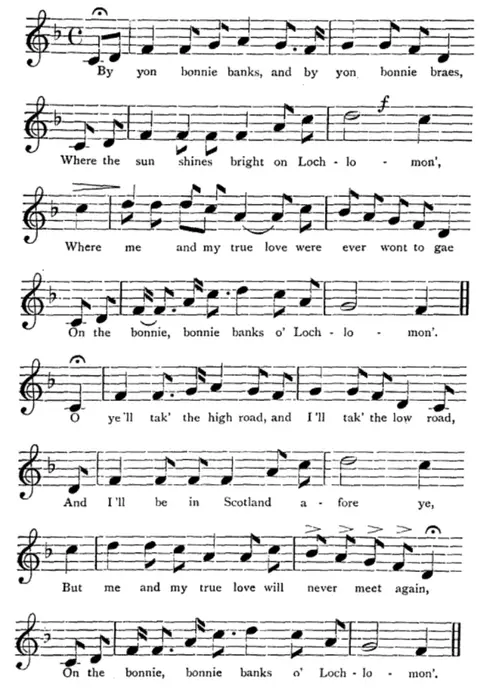
This is the text Robert Ford printed in Vagabond Songs and Ballads of Scotland (Paisley, 1899), the version most people sing today. It is long out of copyright. Runrig’s and other modern arrangements change and add words; those are copyright, so they are not reproduced here.
By yon bonnie banks, and by yon bonnie braes,
Where the sun shines bright on Loch Lomon’,
Where me and my true love were ever wont to gae,
On the bonnie, bonnie banks o’ Loch Lomon’.
ChorusO, ye’ll tak’ the high road, and I’ll tak’ the low road,
And I’ll be in Scotland afore ye;
But me and my true love will never meet again
On the bonnie, bonnie banks o’ Loch Lomon’.
’Twas there that we parted in yon shady glen,
On the steep, steep side o’ Ben Lomon’,
Where in purple hue the Hieland hills we view,
And the moon coming out in the gloamin’.
ChorusO, ye’ll tak’ the high road, and I’ll tak’ the low road, …
The wee birdies sing, and the wild flowers spring,
And in sunshine the waters are sleepin’;
But the broken heart it kens nae second spring again,
Tho’ the waefu’ may cease frae their greetin’.
ChorusO, ye’ll tak’ the high road, and I’ll tak’ the low road, …
Text: Robert Ford, Vagabond Songs and Ballads of Scotland (Paisley: Alexander Gardner, 1899), pages 161 to 162. Ford’s printed page on the Internet Archive.
Chords: Ford printed the melody alone, in F major (one flat, common time), as the score in the pictures below shows. There is no traditional chord set, so every chord sheet you find is someone’s later arrangement.
Runrig’s Loch Lomond: which version is which
The Hampden version is the 2007 CD single “Loch Lomond (Hampden remix)” (Ridge RRS048), credited to Runrig ft Tartan Army: a new version, BBC News reported, with 50,000 fans recorded at Hampden as backing vocals. It was number 1 on the Scottish chart of 18 November 2007 and number 9 in the UK. The earlier studio versions are the 1979 album track on The Highland Connection (5:08) and the 1982 single (4:21).
Runrig did not write the song; they arranged it for a band. The 1979 album line-up played electric and acoustic guitars, bass, drums, organ, accordion and Highland bagpipes, and the song grew longer on stage: the official live video from the Barrowland Ballroom in Glasgow, 2012, runs 8 minutes 10 seconds, against about 3 minutes for the 1930s 78s. Hear the difference in three free, legitimate recordings:
- Runrig, live at the Barrowland, Glasgow, 2012The band’s own video on the Runrig Official YouTube channel, the channel linked from runrig.co.uk; 8 minutes 10 seconds.
- Joseph Hislop, tenor and orchestra, 1931With an orchestra conducted by Lawrence Collingwood, on His Master’s Voice; 3 minutes 17 seconds, on the Internet Archive.
- Maxine Sullivan, swing, recorded 1937The swing hit with Claude Thornhill, from a 1943 British Parlophone pressing whose label says “in fox-trot tempo”; 3 minutes 2 seconds, on the Internet Archive.
Looking for Runrig’s lyrics? The words of their arrangement are copyright, so only the traditional words are printed here; sing along to the official live video above.
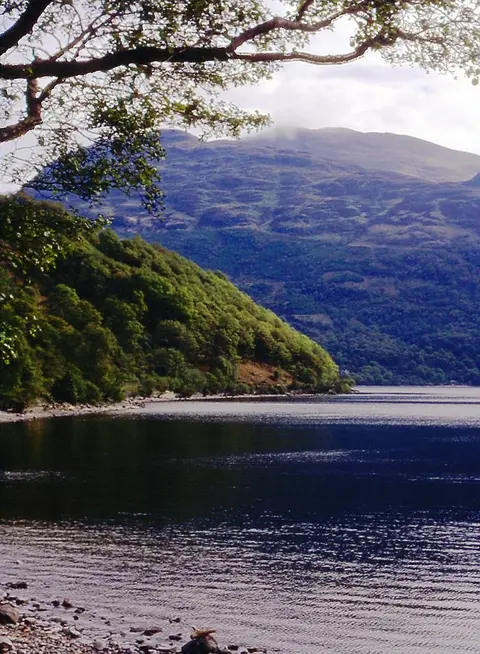
The song and its loch in pictures



Versions and recordings that shaped the song, 1841 to 2019
Dates and catalogue numbers come from the library that holds the item, the Official Charts Company or the discographies named in our sources. This is not a full discography: it lists the versions that changed how the song is known.
| Version | When | What it is | Why it matters |
|---|---|---|---|
| “Bonnie Loch Loman”Song sheet, Paterson & Roy, Edinburgh | 1840 or 1841 | Sheet music arranged by Finlay Dun and John Thomson, with the loch spelled “Loman”. | The first known printing, held by the Morgan Library in New York. Whether it also appeared in the book The Vocal Melodies of Scotland is disputed. |
| “Flora’s Lament for her Charlie”Broadside, Robert MacIntosh, Glasgow | 1849 or later | A street ballad sheet that opens “It’s yon bonny banks, and yon bonny braes”. | The earliest Jacobite framing in print we could find, kept by the National Library of Scotland (RB.m.168(178)). The Ballad Index calls it a patch-up job. |
| “The Bonnie Banks o’ Loch Lomond”Robert Ford, Vagabond Songs and Ballads of Scotland | 1899 | The three verses and chorus most people sing, plus a second, openly Jacobite set of verses. | The source of the words on this page, and an early printed account of the Carlisle execution story. |
| Early recordingsGeorge Alexander; Henry Burr | 1906 and 1908 | Columbia 3294 and Victor 16062, both listed by the Traditional Ballad Index. | Early American commercial records of the song, made decades before the versions people remember. |
| “Loch Lomond” (swing)Maxine Sullivan with Claude Thornhill | 6 August 1937 | A swing arrangement recorded with Thornhill’s septet. | A hit. Some radio stations refused to play a swung folk song, which helped sales. |
| “Loch Lomond” (album track)Runrig, The Highland Connection | 1979 | Track 5, 5:08, on the band’s own Ridge label (RR001). | Runrig’s first recording of the song. |
| “Loch Lomond” (single)Runrig | 1982 | A 7-inch single, Ridge RRS 003. | Entered the UK chart on 8 January 1983 and peaked at number 86, for one week. |
| “Loch Lomond (Hampden remix)”Runrig ft Tartan Army | 2007 | CD single, Ridge RRS048, with backing vocals by 50,000 fans recorded at half time of Scotland v Ukraine at Hampden; released on 12 November for BBC Children in Need. | Number 9 on the UK chart of 24 November 2007, four weeks on the chart: Runrig’s only UK top 10 single. |
| The Last DanceRunrig, farewell concerts | 2018, released 2019 | The farewell shows at City Park, Stirling, released on 16 August 2019 with “Loch Lomond” on disc 3. | Billed as the last time the band would play it live; the Press Association reported a total crowd of 47,000 over the two shows. |
Chart positions are from the Official Charts Company. Runrig catalogue numbers come from a detailed fan-run discography, because the band’s own site does not list them.
What the Scots words mean, line by line
“By yon bonnie banks, and by yon bonnie braes”
Yon means “those over there”, so the singer is pointing at a place they can see or remember. Bonnie is pretty, and a brae is a hillside: the Dictionaries of the Scots Language define it as the brow of a hill.
“Where me and my true love were ever wont to gae”
Wont to gae means “used to go”. The tense matters: the walks are over before the song starts.
“Ye’ll tak’ the high road, and I’ll tak’ the low road”
Two ways home to Scotland. In the tradition Robert Ford recorded in 1899, the low road is the grave: the singer will die, and his spirit will be back in Scotland before his love can travel there alive. Friends of Loch Lomond & The Trossachs read it the same way. The words themselves never say who dies.
“And the moon coming out in the gloamin’”
The gloaming is evening twilight, dusk, and Hieland is Highland: the lovers part on the hillside as the moon rises.
“The broken heart it kens nae second spring again”
Kens nae means “knows no”. In the next line the waefu’ are the sorrowful, and greetin’ is weeping. Together they say that grieving people stop crying in the end, but a broken heart never gets a second spring. That is why the song reads as sad even when it is sung fast.
Documented, or legend?
- Documented: the first known printing is the song sheet “Bonnie Loch Loman”, published by Paterson & Roy of Edinburgh and dated 1840 or 1841 by the Morgan Library.
- Disputed: many sources, including the Traditional Ballad Index, date the song to the book The Vocal Melodies of Scotland in 1841. The Morgan Library, citing the music historian James Fuld, says it was not in any of that collection’s four volumes, even though the sheet is headed as if it were.
- Unknown: who wrote the words or the tune. The Ballad Index lists the author as unknown. Ford quoted a Crieff man, Mr Kippen, who had heard it sung on the streets more than sixty years before 1899, which would put it before the first printing.
- Legend: the Jacobite prisoner at Carlisle. Ford printed it in 1899 as a tradition, and the Ballad Index says the connection with the ’45 remains uncertain.
- Legend: Lady John Scott wrote it. Ford says she picked up a different set of verses in the streets of Edinburgh, and the Ballad Index lists her authorship among the legends.
- Disputed: where the tune comes from. John Purser links it to “The Bonnie Hoose o’ Airlie”, other writers to “The Lowlands of Holland”, and the Irish song “Red Is the Rose” shares the melody. The Ballad Index calls the matter unsettled.
- Documented: a Glasgow broadside, “Flora’s Lament for her Charlie” (1849 or later, National Library of Scotland), sets near-identical opening lines in the story of Flora MacDonald and Prince Charlie.
Where to see the bonnie banks
The song names only Loch Lomond and Ben Lomond. Ben Lomond stands on the east shore, so for the view in the second verse, the mountain across the water, go to the west shore; for the banks from above, climb on the east side. Trains, buses and the A82 are covered in getting to Loch Lomond.
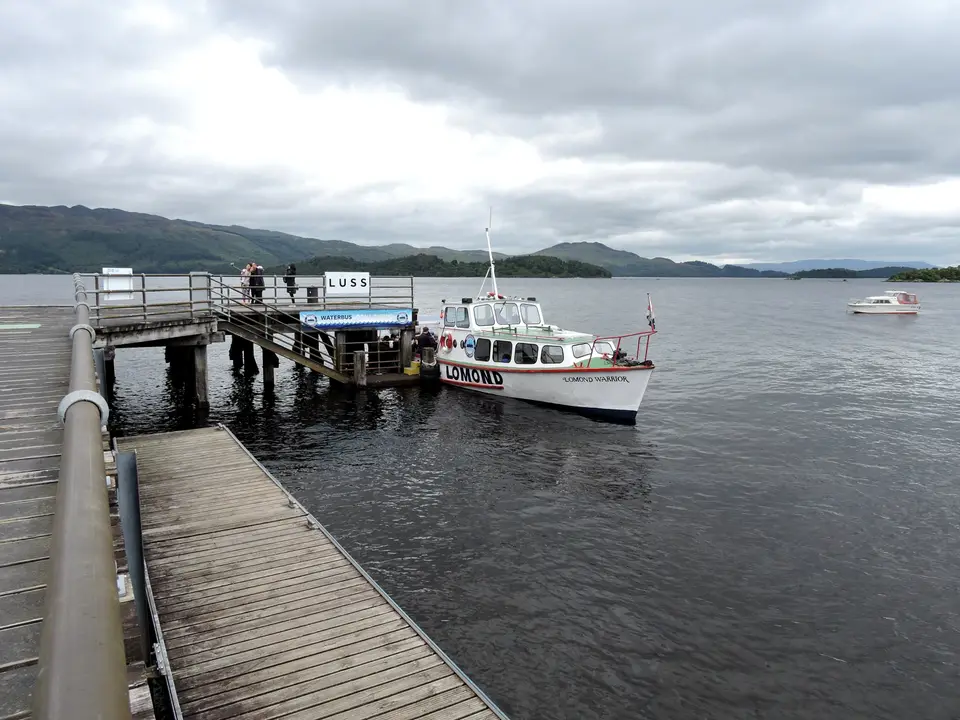
- Luss: the easiest Ben Lomond viewOn the west shore, 9 miles north of Balloch on the A82, with views of Ben Lomond across the loch, according to the National Park. Bus 305 runs from Balloch and the Ember E5 coach from Glasgow; drivers use the large pay and display car park. Ford’s 1899 notes print verses gathered by Miss F. Mary Colquhoun of Luss that set the parting in “bonnie Luss Glen”. Luss also stood in for the fictional village of the TV soap Take the High Road, which ran from 1980 to 2003. Our Luss village guide covers the pier and the walks.
- Inveruglas: the mountain from the north-westFurther up the west shore, the National Park describes views across the water to Ben Lomond and the Arrochar Alps. Its 2019 access guide puts the An Ceann Mor viewpoint 126 m from the visitor centre, up 31 steps, with the nearest bus stop on the A82 by Loch Sloy Power Station and the nearest station at Tarbet, 3.5 miles away. Works were reported at the site in 2025, so check with the National Park that the viewpoint and toilets are open before you go. More in our Inveruglas guide.
- Balloch: the south end by trainScotRail runs about two trains an hour direct from Glasgow. Runrig are among the bands West Dunbartonshire Council says have played the lochside park at Balloch Castle, whose lawns run down to the shore. Balloch village has the station, the piers and the cruise boats.
- Balmaha and Conic Hill: the banks from aboveOn the east shore, the Conic Hill walk climbs 350 m from Balmaha village to a 361 m top over the loch, in 2 to 3 hours. Bus 309 links Balloch and Balmaha via Drymen.
- Rowardennan: the steep side itselfFor the “steep, steep side o’ Ben Lomon’”, the Ben Lomond tourist path climbs 990 m from Rowardennan on the east shore to the 974 m summit, the most southerly Munro; allow 4.5 to 5.5 hours.
Hampden and the end of the night
At Hampden the song became a football anthem. In October 2007, at half time of the Scotland v Ukraine European Championship qualifier, the voices of 50,000 fans were recorded as the backing for a new Runrig version for BBC Children in Need, BBC News reported. Released on 12 November and credited to Runrig ft Tartan Army, it went to number 1 on the Scottish chart of 18 November and number 9 on the UK chart of 24 November 2007, the band’s only UK top 10 single. Their first single of the song had peaked at 86 in January 1983.
The tune travels further than the words: the City of Cologne says the FC Köln anthem “Mer stonn zo dir, FC Kölle” has its origin in “Loch Lomond”.
Runrig ended their own story with it too. Before their farewell shows at City Park, Stirling, in August 2018, the Press Association reported that fans would hear “Loch Lomond” played live by the band for the last time, and the concert album The Last Dance, released in 2019, keeps it near the close.
Questions people ask
What is the story behind the Loch Lomond song?
Nobody knows for certain. The words are a farewell between two lovers who walked the banks of Loch Lomond. The best-known story, printed by Robert Ford in 1899, makes the singer a Jacobite soldier facing execution at Carlisle after the 1745 rising, whose spirit will take the “low road” home. Ford called it a tradition, and the Traditional Ballad Index still calls the Jacobite link uncertain.
What is the original Loch Lomond song?
The earliest known printing is the Edinburgh song sheet “Bonnie Loch Loman” (Paterson & Roy, 1840 or 1841). The words most people sing match the text Ford printed in 1899, given in full above. Runrig’s version, first recorded in 1979, is a modern arrangement of that traditional song, not the original.
What is the meaning of you take the high road and I'll take the low road?
The high road is the ordinary road home and the low road is usually read as death: the singer will die, and his spirit will be back in Scotland before his love can travel there. That reading is a tradition first printed by Ford in 1899; the words themselves never say who dies.
Why is Loch Lomond played at weddings?
No documented origin explains the custom, but the chorus is easy for a whole room to join and the words are about parting, which suits the last song of the night. If you want it at your own wedding, tell the band or ceilidh caller which mood you mean: slow and sung, like the 1931 Joseph Hislop recording, or a full-band singalong in the Runrig style, and where in the evening it should go. For a venue by the water, see our wedding venues compared.
Is Loch Lomond Irish or Scottish?
Scottish. It is about a Scottish loch, and the earliest known printings come from Edinburgh and Glasgow. The Irish song “Red Is the Rose” uses the same tune, and the Clancy family held that the Irish song came first; the Traditional Ballad Index calls the tune’s origin unsettled.
Is Loch Lomond a sad song?
Yes, in its words. It is a farewell, and the last verse says a broken heart never gets a second spring. It is often sung fast and cheerfully, which the music historian John Purser called “inane chirpiness”.
When did Runrig record Loch Lomond?
First on the album The Highland Connection in 1979, then as a single in 1982 that reached number 86 in January 1983. The Hampden version is the 2007 charity single “Loch Lomond (Hampden remix)”, with 50,000 Scotland fans on backing vocals: number 1 in Scotland and number 9 in the UK. The band’s official live video was filmed at the Barrowland Ballroom, Glasgow, in 2012.
What key is Loch Lomond in, and what are the chords?
Robert Ford printed the tune in 1899 in F major, as a melody line with no chords. There is no traditional chord set, so any chord sheet is a later arrangement.
Where can I find Runrig’s Loch Lomond lyrics?
Runrig’s arrangement is copyright, so this page prints only the traditional words. To follow along with Runrig, watch the band’s official live video of “Loch Lomond” (Barrowland Ballroom, Glasgow, 2012) on the Runrig Official YouTube channel; the traditional 1899 words are printed in full above.
Where are the bonnie banks of Loch Lomond?
Anywhere on the loch shore; the song names no single spot. Balloch, Luss, Balmaha and Rowardennan put you on the banks, while Conic Hill and Ben Lomond give the view from above.